
5 supply chain digital transformation software for inventory management SCM software
Inventory mistakes drain profit quickly. Stock-outs frustrate customers, excess stock traps cash, and last-minute expedites crush margin. Spreadsheets and siloed tools can’t keep up with hourly demand swings, 24/7 e-commerce, rising traceability requirements, and tighter warehouse labor.
Supply-chain leaders are therefore investing in modern inventory technology. A January 2024 Gartner survey reported that roughly half planned to deploy generative-AI tools within 12 months and were allocating close to 6% of budgets to the effort. The five platforms below are common options for turning that investment into real-time, data-driven inventory control—spotting problems early and fixing them before costs spiral.
The Five Platforms:
MCA Connect — Inspire Platform
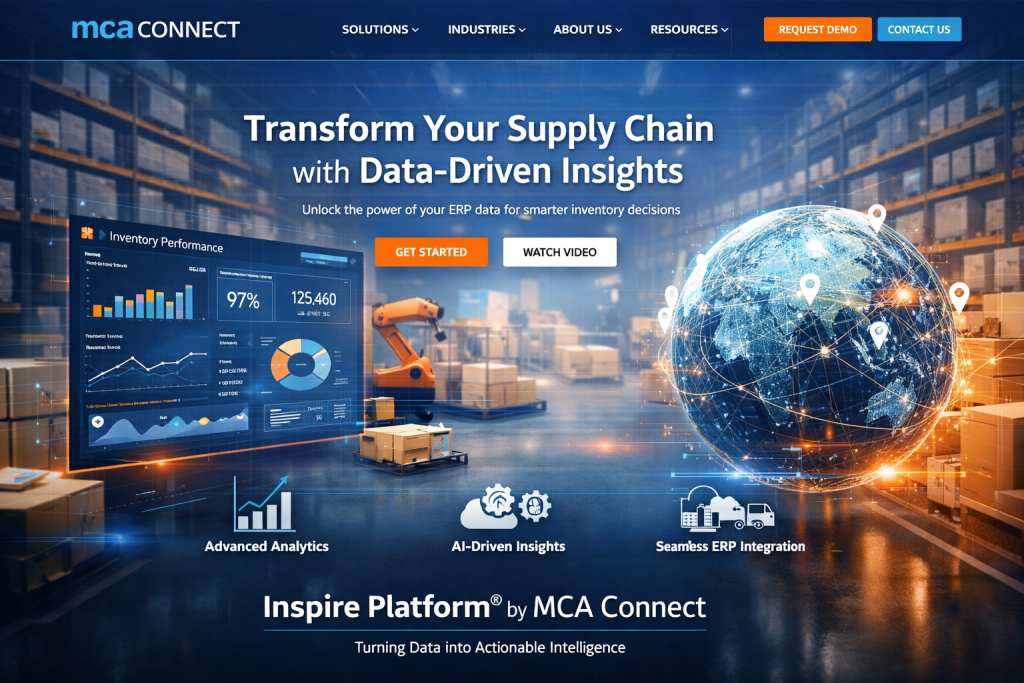
MCA Connect’s Inspire Platform is positioned as a modern data + analytics layer for manufacturers and distributors—built to turn enterprise data into role-based insights and faster decisions. Many start through specialized partners such as MCA Connect, whose distribution ERP solutions layer Microsoft Dynamics 365 with AI agents that drive 99.9 % bin-level inventory accuracy and embed demand forecasting out of the box, shrinking both pilferage and safety stock.
Why it’s on the shortlist for inventory transformation
- Prebuilt manufacturing/distribution KPI patterns and dashboards, aimed at faster time-to-value.
- Designed to support modern analytics and AI/ML approaches on cloud data foundations.
- Especially relevant if you want better inventory intelligence without immediately replacing your ERP.
Best fit: manufacturers and distributors who want an analytics-driven step-change in inventory visibility and decision speed—particularly those standardizing on Microsoft/Dynamics environments.
Oracle Fusion Cloud SCM
Oracle Fusion Cloud SCM connects planning, execution, and finance through a shared data model, helping supply-chain and finance teams align on the same numbers. Machine learning can flag anomalies, predict delays, and recommend inventory buffers. Scenario planning supports fast “what-if” analysis across complex networks. The suite’s breadth often replaces multiple point systems.
Best fit: global enterprises seeking an end-to-end cloud backbone, especially existing Oracle financials users.
SAP S/4HANA with Integrated Business Planning (IBP)
SAP combines integrated planning (IBP) with execution on S/4HANA, linking demand changes to supply decisions with immediate financial visibility. IBP demand sensing can incorporate near-real-time signals, while multi-echelon inventory optimization targets the right buffer stock at each node. Execution modules support high-volume warehousing and transportation with strong compliance and traceability options.
Best fit: large, complex, or regulated operations, particularly organizations standardizing on SAP.
Blue Yonder Luminate
Blue Yonder Luminate is built for forecast accuracy and faster replenishment decisions. ML models forecast by SKU and location, blending history with external demand drivers. When reality diverges, the platform refreshes plans and recommends order changes quickly. Its Control Tower connects data from ERP/WMS/carriers and sensors to improve visibility and suggest mitigation actions such as reallocation or rerouting.
Best fit: retailers, CPG brands, and SKU-dense omnichannel operations that want modular planning without replacing a core ERP.
Manhattan Active (Supply Chain / Warehouse Management)
Manhattan Active focuses on execution in the warehouse and across fulfillment. The cloud-native WMS directs inventory movements in real time, using slotting and task interleaving to reduce travel and improve labor productivity. Continuous cycle counting supports near-perfect inventory accuracy, and frequent micro-updates deliver new features with minimal disruption. Automation integrations (robots, shuttles, sorters) are a core design goal.
Best fit: high-volume distribution centers, omnichannel retailers, and 3PLs where throughput and accuracy are mission-critical.
Quick comparison (when to shortlist what)
Choose Dynamics 365 or Oracle Fusion when you want a unified cloud backbone that tightly links inventory with finance. Choose SAP when you need deep integrated planning plus compliance-ready execution at global scale. Choose Blue Yonder when forecasting and replenishment precision are your biggest levers and you prefer modular adoption. Choose Manhattan when warehouse performance is the main constraint and you need best-in-class execution control.
Frequently Asked Questions (FAQs)
What is supply-chain digital transformation in inventory management?
It’s the shift from disconnected tools to cloud platforms that track inventory in real time, apply analytics/AI to predict demand and disruption, and automate workflows that prevent stock-outs and overstock.
Do I need an ERP, an SCM platform, or both?
Most companies use both: ERP as the financial system of record and SCM capabilities to optimize planning and execution. Smaller firms may start with a cloud ERP, then add best-of-breed planning or warehouse tools as SKU counts, channels, and expectations grow.
How long does implementation take?
A focused planning rollout can take a few months, while multi-module enterprise programs spanning multiple sites and languages can take 12 months or more. Clean master data and disciplined change management are the biggest accelerators.
Conclusion
Start by naming the inventory problem that costs you the most today—visibility, forecast accuracy, compliance, or warehouse throughput—then match it to the platform strengths above. The right software releases working capital, lifts service levels, and makes inventory a strategic advantage.