
5 Secure Video Hosting Services With DRM That Vimeo’s “Private” Mode Lacks
Imagine spending three months filming a paid video course—only to see the lessons reposted on a Telegram piracy channel days after launch.
The real problem isn’t your marketing; it’s Vimeo’s unencrypted “private” setting, which a basic browser plug-in can rip in minutes.
You deserve stronger protection. This guide compares five hosts that apply true, hardware-level DRM so your revenue—and your hard-won IP—stay where they belong.
How we picked the contenders
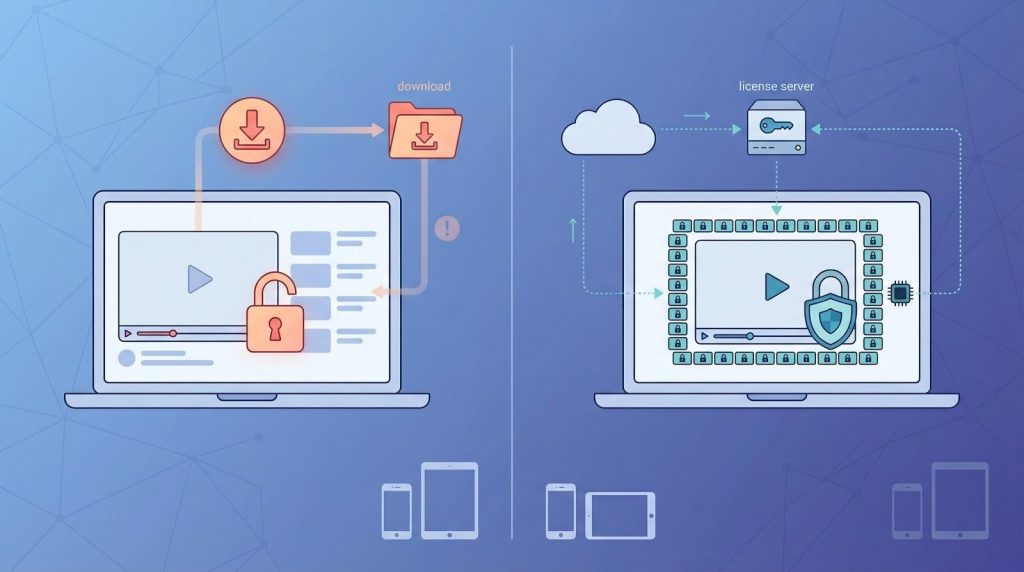
We reviewed the first 20 Google search results for “secure video hosting,” sifted through dozens of Reddit threads from frustrated course creators, and ran “can I rip this?” plug-in tests on every platform that claimed privacy.
Each service then earned a score across five weighted factors:
- Security strength (30 percent)
- Ease of integration and daily use (20 percent)
- Cost-effectiveness (20 percent)
- Marketing and analytics muscle (15 percent)
- Support plus product roadmap (15 percent)
A perfect score totals 100. Any platform without true DRM failed the first category and never reached our spreadsheet. The five that passed now step into the spotlight.
Why Vimeo’s “private” setting falls short
Vimeo offers a row of privacy toggles—unlisted links, passwords, even domain whitelists. They appear solid, yet they guard an unencrypted video stream.
Open your browser’s developer tools while a “private” Vimeo video plays. In under 15 seconds you can spot the MP4 or M3U8 playlist, copy the URL, and watch the video outside your paywall. Popular Chrome extensions make the download one click away.
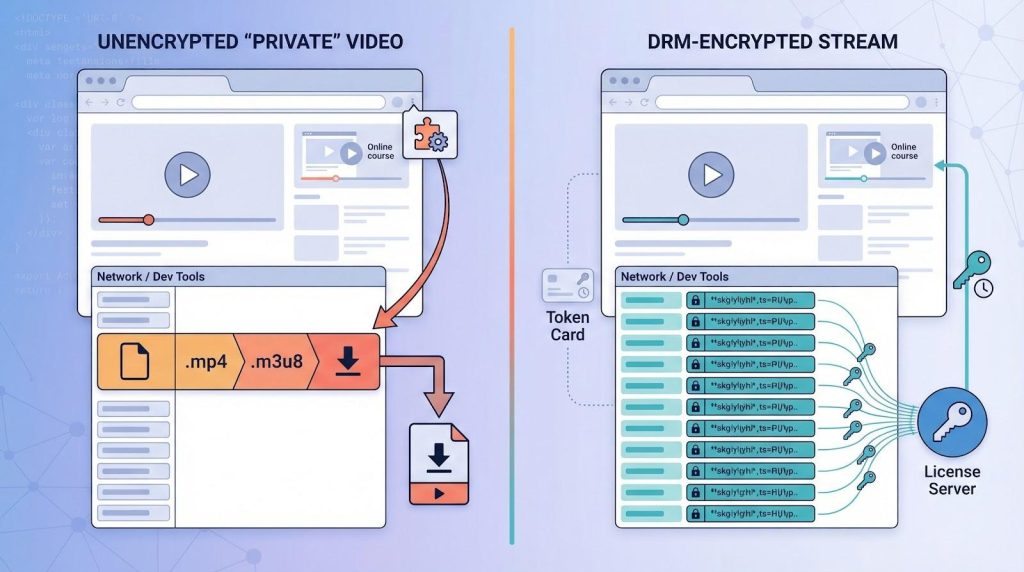
We ran the same extension against an encrypted Spotlightr clip. The tool captured only gibberish: tiny, scrambled TS segments paired with time-limited access tokens. Without the decryption key the video refused to play, proving that real DRM blocks casual pirates.
Until Vimeo adds hardware-level DRM to its standard plans, those privacy switches act like locks on a screen door. If your course revenue or client IP relies on staying behind a paywall, choose a host that encrypts every frame, not one that simply hides the address.
Spotlightr – secure video made simple
Spotlightr tops our list because it locks down content without asking you to think like a network engineer.
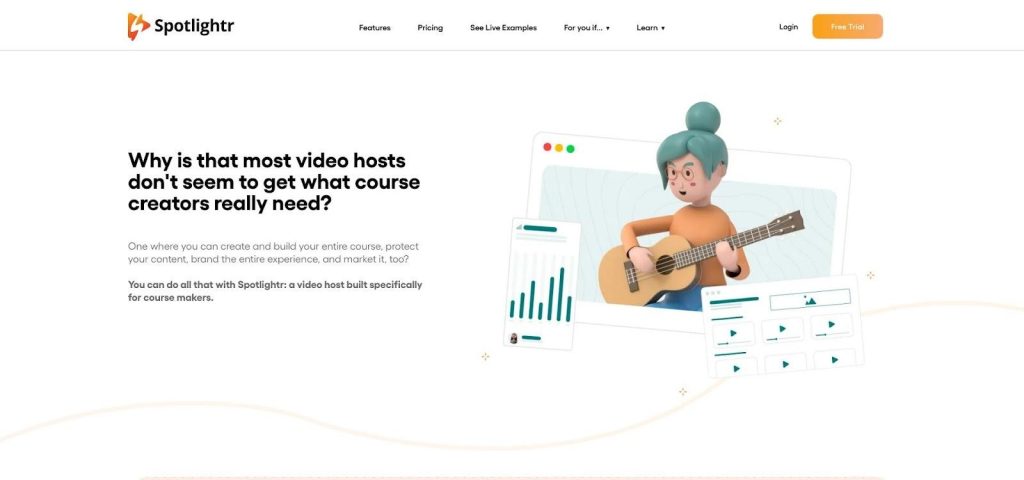
Spotlightr course creator secure video hosting interface screenshot
Upload a file, switch on “Secure Video,” and the platform slices your footage into tiny HLS segments, encrypts every chunk, and issues expiring access tokens. Anyone who lifts the stream URL collects only scrambled data, not a usable copy.
Protection means little if viewers face hurdles, so Spotlightr keeps playback smooth. The player loads quickly, tracks viewer progress, and respects closed-caption files. Embed it on WordPress, Teachable, or any HTML page and it plays without fuss.
Beyond security, Spotlightr drives growth. Gate videos with an email form, trigger a call-to-action at the two-minute mark, or send viewing data straight to your CRM. These tools turn passive videos into active funnel assets.
Pricing stays simple. The Plus plan costs $21 a month when billed yearly and includes unlimited videos, interactive features, and 600 GB of bandwidth. Higher tiers add more bandwidth without hidden overage fees.
Support feels personal. Submit a ticket and a human replies—often with annotated screenshots—within a few hours. If you need strong security and marketing agility in one dashboard, Spotlightr is a reliable choice.
SproutVideo – security knobs without the learning curve
SproutVideo feels instantly familiar: drag, drop, publish, yet it hides a deep set of locks for those who need them.
Flip on login protection and each viewer must authenticate before a single frame loads. Want tighter control? Restrict playback to specific IP ranges or fence off entire countries with two clicks. On the Tree plan the real magic appears: dynamic watermarks that stamp every stream with a viewer’s email. If that recording surfaces online, you know exactly whose account leaked it.
Integration is painless. SproutVideo hands you a lightweight iframe or a WordPress block, plus direct hooks into HubSpot and Mailchimp. Leads flow straight into your campaigns and the dashboard plots heat maps so you see where prospects bail or binge.
Budgets like it too. The Seed tier starts at $10 a month for hobby projects, while $35 unlocks serious privacy tools, generous bandwidth, and analytics. Step up to $75 when you need watermarking and single sign-on, still far below Wistia’s triple-digit entry fee for weaker protection.
SproutVideo skips flashy AI add-ons and focuses on the fundamentals: strong encryption, viewer-level analytics, and billing that grows sensibly. If you want peace of mind without a tech headache, it deserves a close look.
VdoCipher – Hollywood-grade DRM for mission-critical courses
VdoCipher Hollywood-grade multi-DRM video security platform screenshot
Some content needs vault-level protection. VdoCipher provides it by wrapping every stream in Google Widevine and Apple FairPlay, the same multi-DRM armor trusted by Netflix.
During playback the player requests a short-lived decryption key from VdoCipher’s license server. Without that key the encrypted chunks stay useless. Browser plugins return nothing, and even network sniffers yield unreadable data.
VdoCipher also overlays a moving, user-specific watermark. If someone resorts to screen recording, their email or phone number drifts across the frame, making leaks traceable.
The price for that iron wall is a steeper setup curve. You can paste an embed code or WordPress plugin for basic sites, but custom apps usually integrate through SDKs. After launch the workflow fades into the background: upload, set bandwidth limits, and watch licenses in the dashboard.
Pricing works on annual credits. The popular $129 tier covers roughly 500 GB of delivery for the year. Heavy users can prepay larger blocks or top up at about $0.25 per GB. You pay for protection, not marketing extras; VdoCipher focuses squarely on keeping pirates out.
Gumlet – speed meets multi-DRM
Gumlet started as an image-optimization CDN, so raw speed is baked in. When the team added video hosting, they layered on Widevine and FairPlay, giving every stream enterprise-level encryption without slowing the first frame.
Videos ingest, transcode, and cache across a multi-CDN mesh. Viewers hit the nearest edge, see the first frame in under a second, and never notice the security handshake beneath. For global classrooms or membership sites with audiences from Manila to Madrid, that latency edge matters.
Gumlet’s dashboard lets you turn on domain restriction, sign URLs with expiry windows, and overlay dynamic watermarks that drift across the frame. Pirates hate chasing moving text; honest students barely notice it.
Billing is usage based. Storage costs $5 per 1 000 minutes, and delivery is $1 per 1 000 minutes. If you go quiet for a month, your bill shrinks. Power users can pre-commit for even lower per-gig rates, and there is no forced upgrade ladder.
The trade-off is fewer marketing gadgets. You will not find built-in email gates or quizzes. Gumlet focuses on infrastructure: strong stream security plus fast playback. Pair it with your own funnels and you have a lean, global video stack that grows with you.
Cloudflare Stream – pay-as-you-go protection for developers
Cloudflare Stream pay-as-you-go secure video for developers screenshot
If you already rely on Cloudflare for DNS or caching, Stream feels like flipping another switch in the same dashboard. Upload a file, grab a Stream ID, then hand visitors a signed token that expires in minutes. No token, no playback.
Tokenized security is not full DRM, but it blocks casual download attempts and does so with near-zero latency on Cloudflare’s global edge. In our tests, a 5-minute clip reached first frame in under 2 seconds for viewers in Sydney and São Paulo.
Costs stay lean. Storage is $5 per 1 000 minutes, and delivery is $1 per 1 000 minutes. If nobody watches this month, you pay only for storage; if a launch goes viral, billing scales automatically without tier negotiations.
Stream ships a minimalist player, basic view analytics, and nothing more. There is no email capture or watermark toggle. For teams that can wire their own marketing layer, or simply need fast, protected video inside an app, Stream provides reliable infrastructure at café prices.
How the five stack up at a glance
Claims are easier to trust when you see the data side by side. The grid below summarizes what each host secures, how it locks playback to your site, and the entry price for full protection.
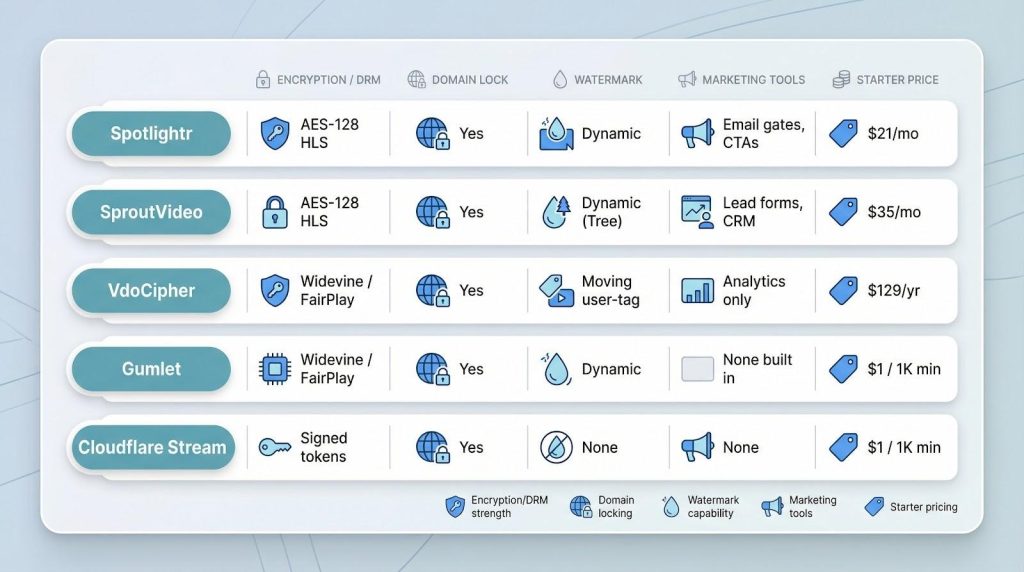
Platform | Encryption or DRM | Domain lock | Watermark | Marketing tools | Starter price |
Spotlightr | AES-128 HLS, expiring tokens | Yes | Optional dynamic | Email gates, CTAs, heat maps | $21 per month |
SproutVideo | AES-128 HLS | Yes | Dynamic (Tree plan) | Lead forms, HubSpot sync | $35 per month |
VdoCipher | Widevine and FairPlay | Yes | Moving, user-tagged | Basic analytics | $129 per year |
Gumlet | Widevine and FairPlay | Yes | Dynamic | None built in | Usage: $1 per 1 000 min delivered |
Cloudflare Stream | Signed URL tokens | Yes | No | None built in | Usage: $1 per 1 000 min delivered |
Conclusion
Use the table as a shortcut, but let your goals guide the pick. Need lead-capture overlays? Choose Spotlightr or SproutVideo. Selling a high-ticket masterclass you cannot risk pirating? VdoCipher or Gumlet fit. Building a custom app and just want fast, inexpensive video? Cloudflare Stream is the simplest path.
Frequently asked questions
Can I secure videos by hosting them on my own server?
You can password-protect a folder, but once an unencrypted MP4 streams, anyone can copy it. You will also shoulder global CDN bills, transcoding, and device-compatibility work. A dedicated host bundles that infrastructure plus encryption for less than $5 a day.
Is DRM truly different from a password or unlisted link?
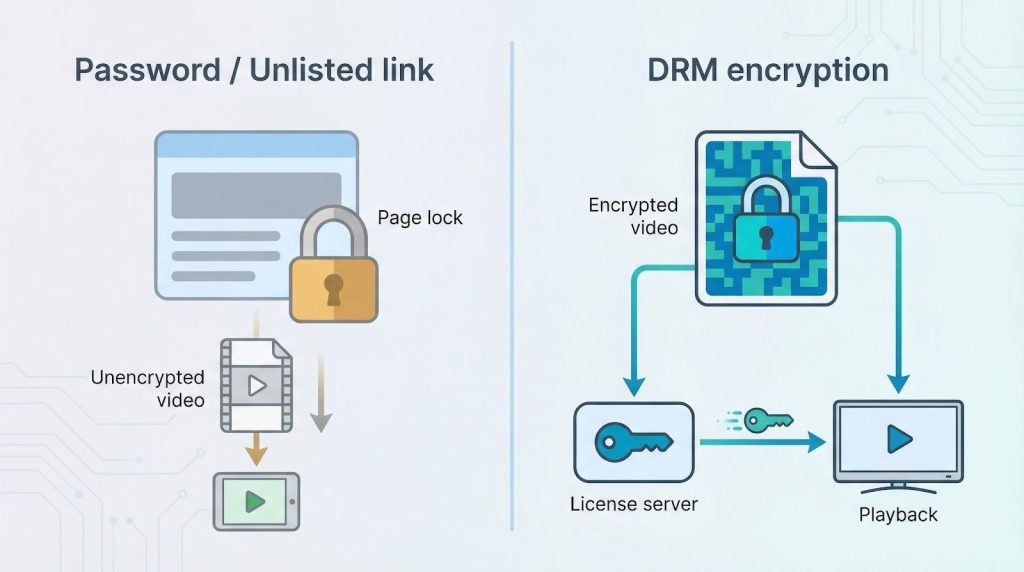
Yes. Passwords gate the page, not the file. DRM encrypts the video itself. Even if someone intercepts the stream, they see scrambled bytes unless a license server supplies a decryption key during playback.
Can any platform block screen recording completely?
No. The “analog hole” means a determined pirate can always aim a phone at the monitor. Strong hosts add personal watermarks and log viewer identities, making leaks traceable and far less tempting.
Are there any free secure video hosts?
Free tiers exist, but none include strong DRM because license fees and CDN traffic cost real money. The good news: usage-based pricing from Cloudflare Stream or entry plans from Spotlightr start around $3 to $5 a month.
Will adding a secure embed slow my page?
Not if you choose wisely. All five top picks load with async iframes or lightweight scripts and deliver video from edge servers. In most cases they outperform a self-hosted file and keep Google’s Core Web Vitals happy.