
Top Business Internet Providers for Small Businesses
The small-business broadband scene has changed fast. Public-utility fiber now trades blows with national cable, telco, and 5G contenders, giving your company more choice—and more homework—than ever. The 13 carriers below all sell commercial plans across multiple metro markets, and the latest FCC Broadband Data Collection shows at least one fiber network covering most business addresses in major cities.
Abundance helps only if you can see the trade-offs. The sections that follow score every provider on coverage, speed, reliability, support, scalability, and price so you can pick bandwidth that keeps your team productive without torching the budget.
How we picked the winners
We scored each provider on six data-backed factors that shape small-business connectivity: coverage, speed, reliability, support, scalability, and price. A weighted formula rolled those inputs into a single 100-point score.
Coverage carried the most weight. Using the FCC Broadband Data Collection (June 2025), we mapped each carrier’s business availability at the address level across multiple metros, not by ZIP code.
To judge speed, we took each ISP’s fastest published business tier and compared it with recent user-reported tests. Municipal 10 Gbps symmetric fiber set the ceiling; legacy DSL and GEO satellites set the floor.
Reliability, support, and enterprise features filled out the middle. We reviewed customer feedback and published SLAs to see who answers the phone at 2 am and who lets it ring. Finally, we normalized price to cost per megabit so a 5G budget plan could stand beside a gigabit fiber circuit.
The resulting ranking reflects measurable results, not marketing claims.
1. WOW! Business – best for customer service and balanced performance
If your office sits inside WOW!’s footprint—the overbuilder operates across cities like Knoxville, Charlotte, Augusta, Columbus, Cleveland, and Newnan—it’s the sleeper hit worth checking first. The hybrid-fiber-coax network reaches roughly one-third of business addresses in each market it serves, and posts download speeds up to 1.2 Gbps with 50 Mbps uploads, enough headroom for cloud backups, point-of-sale traffic, and a dozen simultaneous Zoom feeds.
What sets WOW! apart from other cable options is its people. Business customers praise quick installs and plain-language support that answers on the first ring. New accounts secure a 300 Mbps promo at roughly thirty dollars a month, and current regional pages such as WOW!’s Knoxville, TN Business Internet listing tack on free installation plus three free months. That low cost per megabit leaves budget for a wireless fail-over line.
Reliability holds steady. Because WOW! is an over-builder, its coax nodes serve fewer users than incumbent cable plants, so peak-hour slowdowns are rare. Pair that steadiness with no data caps and optional static-IP blocks, and you get a cable connection that feels close to fiber for daily workloads.
Bottom line: if WOW! is available at your address, move it to the top of your shortlist. You’ll trade a few upload megabits for standout support and predictable billing. In a market where most providers lead with raw speed, WOW! wins on the metric that matters when something breaks—responsiveness.
2. AT&T Business – best for nationwide fiber reach
AT&T has served businesses for over a century, yet its network feels fresh. Across the major metros it covers, about half the city can order symmetrical fiber up to 5 Gbps, while most remaining blocks fall back to IPBB or fixed wireless. This footprint gives AT&T a near-universal presence, which helps companies that juggle multiple offices or kiosks across town.
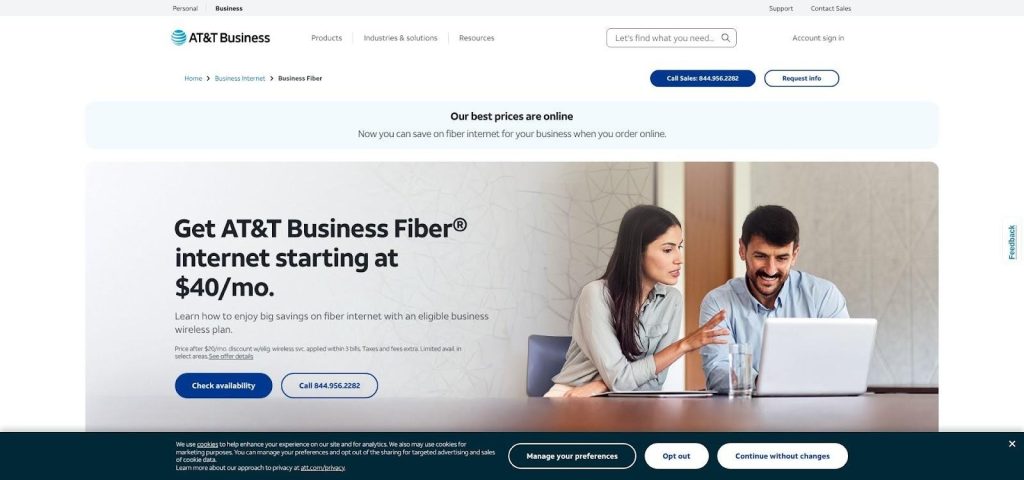
Performance backs up the map. Customer tests often hit the advertised 940 Mbps on the gig tier, and latency sits in single digits, keeping voice and video crisp. Mission-critical sites can upgrade to AT&T Dedicated Internet with a 99.95 percent SLA and a four-hour truck-roll window.
Support feels corporate yet competent. Business calls route to regional teams during the day, then to a national center after hours—still quicker than a residential queue. Static-IP blocks, managed routers, and SD-WAN bundles are available, so you can scale without switching vendors.
Price lands in the middle. Fiber 300 runs about seventy-five dollars a month on a one-year term, with gig service climbing into the low hundreds. While not the cheapest, the plan avoids cable’s upload bottleneck and offers the broadest in-market coverage, making AT&T a safe long-term choice for many small and mid-sized firms.
3. Comcast Business – best when you need gig speeds almost anywhere
Comcast passes about ninety percent of business addresses in the metros it serves, so if cable lines reach your storefront, a business plan is likely available. Standard tiers top out at 1 Gbps down with 200 Mbps up, and a new 2 Gbps option is rolling through most cities. Uploads trail fiber, yet for download-heavy work—large design files, daily software pulls, continuous video streams—this pipe delivers.
Comcast also brings a solid toolkit. Connection Pro adds an LTE fail-over modem that activates during outages. SecurityEdge blocks malware at the network edge, and static-IP options let you run on-prem servers without late-night IT calls.
Pricing starts near sixty-nine dollars for 100 Mbps, then resets higher after a two-year term. Mark your renewal date and negotiate; Comcast often discounts to keep accounts when fiber competitors enter your area.
Support has improved. Business customers skip the residential queue, and regional techs can usually roll a truck the same day for critical issues. Cable is a shared medium, so evening slowdowns can appear in dense corridors, but recent node splits have eased congestion.
When fiber is out of reach and you need gig-class speed fast, Comcast Business offers a near-ubiquitous safety net packed with extras. Just remember to renegotiate before the promo clock runs out.
4. Spectrum Business – best cable choice where Charter overlaps
In many markets, small businesses enjoy a rare luxury: two major cable operators. Charter’s Spectrum overlaps Comcast across wide swaths of the country and holds its own.
The top plan delivers 940 Mbps down and 35 Mbps up. Uploads may not wow creative studios, but for point-of-sale, cloud files, and dozens of HD streams, performance stays smooth. Charter rebuilt much of its plant during post-merger upgrades, so congestion is uncommon and latency hovers near 20 ms.
Billing keeps things simple. Most tiers carry no contract, no data caps, and a flat promo price—about sixty-five dollars for 200 Mbps. Spectrum will even buy out an existing contract up to five hundred dollars, letting startups move or pivot without early-termination pain.
Extras line up neatly. Static IP blocks cost about fifteen dollars a month. Hosted Voice puts phones and internet on one bill, and businesses adding wired phones, access points, or other network hardware may also need structured cabling services to connect those systems throughout the space. A managed Wi-Fi option blankets customer areas with branded splash pages—handy for cafés and salons.
Support sits mid-pack. You get 24/7 phone reps plus local techs who can roll the same day when a node hiccups.
If Spectrum is available at your address, it’s likely the fastest path to high-speed service. With month-to-month flexibility, risk stays low. Keep tills ringing and cloud apps running without the contract drag.
5. TDS Telecom – best gigabit bargain in pocket neighborhoods
TDS proves you don’t need deep pockets to join the gigabit club. In the slivers of suburbs where its fiber runs, the company advertises 1 Gbps symmetrical for roughly fifty dollars a month during the introductory term. Choose the price-for-life option and the rate still stays under eighty, cheaper than many 300 Mbps cable plans.
Installs move quickly because the overlay is new and lightly subscribed. Customers report full-gig speeds day and night, suggesting plenty of backbone capacity—ideal for CAD files or overnight backups.
Business accounts can add static-IP blocks, phone lines, or a managed Wi-Fi service. TDS won’t match AT&T’s broader cloud menu, yet for small offices that just want fast, clean bandwidth, these extras hit the mark.
Coverage is patchy. One street has fiber; the next falls back to DSL. Always punch your exact address into TDS’s checker before penciling it into the budget. If you land inside the green zone, you’ll pocket significant savings without giving up enterprise-grade performance.
6. Frontier Business – best telco turnaround story
A few years ago, “Frontier” meant slow DSL and customer-service pain. After restructuring, the company rewired parts of its territory with XGS-PON fiber and changed the story.
Where fiber is live—pockets across suburban markets and rural business parks—you can order symmetrical 500 Mbps for about fifty dollars or step up to 2 Gbps for under one-fifty. Uploads match downloads, latency sits in single digits, and no data caps appear in the fine print.
Static-IP blocks and SD-WAN bundles are on tap, and business calls now route through regional hubs instead of a generic queue. Early adopters report installs within ten days and speed tests that meet spec from day one.
Coverage is spotty. Frontier’s map shows gigabit islands surrounded by large DSL zones. Always check your exact address, not just a ZIP code. If you land on a fiber street, you gain a sleeper contender that pushes bigger incumbents to sharpen their quotes.
7. EarthLink Business – best one-stop aggregator
Choosing an ISP can feel like juggling sales pitches. EarthLink simplifies the process by reselling bandwidth from AT&T, Frontier, Verizon, and regional carriers, then wrapping everything in one bill and support line.
The model shines for multi-location companies. A retailer with shops in three different metros can stay with EarthLink even if each site ends up on a different underlying network. Contract terms, SLAs, and escalation paths stay consistent, saving your ops team from tracking multiple portals and PINs.
Speeds mirror the local plant feeding your address—up to 5 Gbps where fiber is present, down to 100 Mbps on legacy copper. Pricing follows the source carrier plus a small premium, but EarthLink counters with no-cap data policies and customer-care scores that beat many of the giants it rides on.
If you run one office and already know you want a specific local carrier, going direct is cheaper. For organizations that value a single point of contact, EarthLink delivers that convenience without sacrificing local performance.
8. T-Mobile Business Internet – best plug-and-play backup
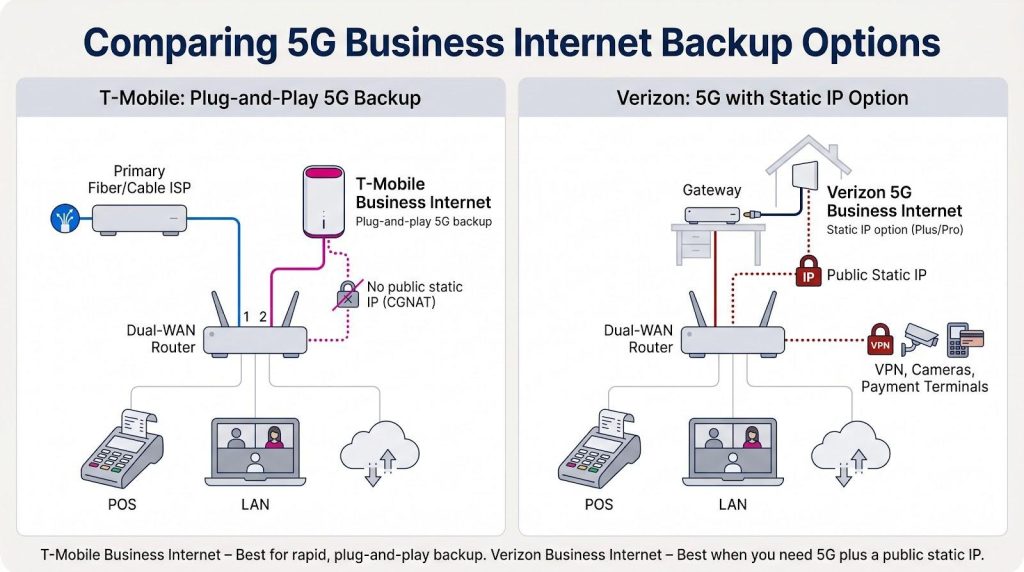
Sometimes you just need connectivity now. T-Mobile ships a 5G gateway, you plug it into a wall, and fifteen minutes later the office is online at roughly 100 Mbps down and 20 Mbps up. No trenching, no permits, no waiting for a cable tech.
That speed won’t run a render farm, yet it easily covers point-of-sale, VoIP, and everyday SaaS traffic. Unlimited data at fifty dollars a month keeps costs predictable, and the month-to-month plan lets you cancel the day fiber reaches your suite.
Many small businesses leave the gateway on standby behind a dual-WAN router; if a backhoe cuts the primary line, the 5G link takes over without dropping a Zoom call. The service uses carrier-grade NAT, so it lacks public static IPs. If you host inbound services, plan on a VPN tunnel or choose Verizon’s 5G option below.
For speed to deploy and predictable backup pricing, T-Mobile remains hard to beat.
9. Verizon Business Internet – best wireless with static IP
Verizon’s 5G Business Internet takes the plug-and-play model and layers on enterprise extras. Most metro addresses qualify for C-band 5G, delivering 100 to 200 Mbps down and up to 50 Mbps up. In downtown line-of-sight zones, the Ultra Wideband signal can top 300 Mbps.
The standout feature is a true public static IP. That single option turns a backup link into a viable primary connection for firms that host VPN gateways, cameras, or payment terminals that require fixed whitelists. Choose the Plus or Pro plan, request a static IP, and Verizon provisions it during install.
Verizon prefers to send a tech who mounts an external antenna for stronger signal. This adds a few days over T-Mobile’s self-setup but yields steadier throughput. Pricing starts near sixty-nine dollars a month on a two-year term, with discounts for existing Verizon wireless lines.
Use cases fall into two camps. First, as an always-on fail-over that mirrors your public IP setup so switchover is seamless. Second, as the primary pipe for pop-up retail, construction trailers, or rural offices where fiber’s arrival date is unknown. Either way, you get the speed of 5G with the predictability of a wired IP address.
10. Starlink Business – best lifeline beyond the grid
Drive thirty minutes into the hills and every cable line disappears. That is where SpaceX’s Starlink steps in. A dish the size of a pizza box talks to a low-orbit satellite network and delivers about 200 Mbps down and 30 Mbps up to any rooftop with a clear sky view.
Latency around thirty milliseconds keeps Zoom, VoIP, and cloud desktops usable, a feat older geostationary satellites could not match. Hardware costs roughly three hundred fifty dollars, and business priority service starts near sixty-five dollars a month. Expensive compared with basic cable, but when the alternative is 6 Mbps DSL, the premium feels justified.
Setup is do-it-yourself: mount the dish where the app shows no obstructions, run one cable inside, and connect the PoE router. Minutes later you have broadband that ignores local poles, wires, and cell towers. Many urban firms also keep a kit boxed and ready in case a construction mishap cuts terrestrial links.
Speed can fluctuate with satellite traffic, so keep cable or 5G for daily use if possible. For farms, construction sites, or mountain lodges where fiber remains a distant promise, Starlink lets teams work online instead of driving to town for Wi-Fi.
11. Viasat Business – best last-resort broadband with predictable costs
When even Starlink cannot clear the tree line, Viasat’s geostationary satellites keep the lights on. Plans reach 100 to 150 Mbps down and about 4 Mbps up. Latency sits near 600 ms, so real-time video chat feels laggy, yet email, point-of-sale, and cloud dashboards load without fuss.
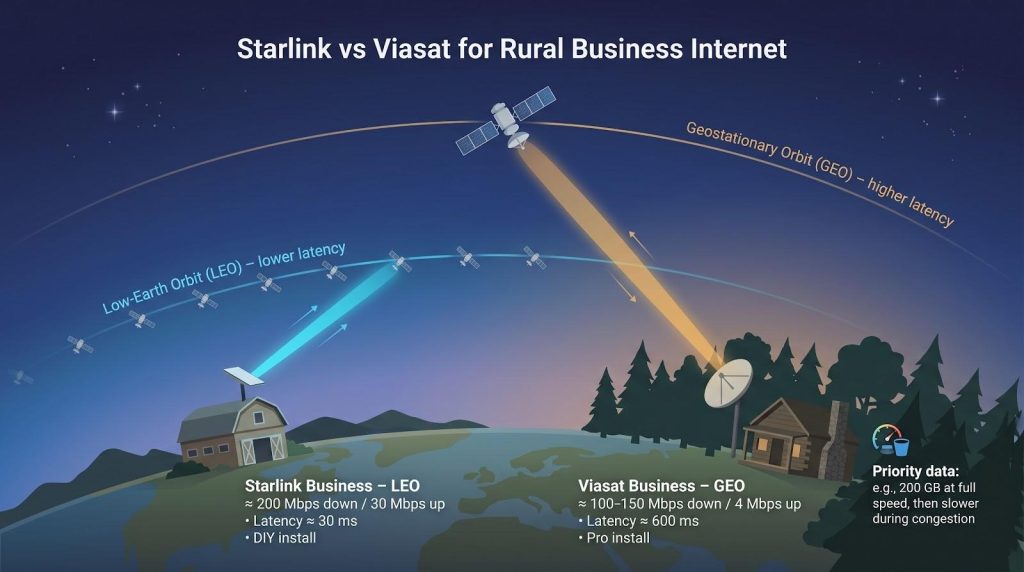
Each package includes “priority data.” A typical 100 Mbps plan offers unlimited data with a 200 GB priority allowance for roughly two hundred dollars a month. After that threshold, traffic still flows but slows during congestion. Because billing is based on a data bucket rather than a hard cap, monthly costs stay predictable.
Professional install is required. A two-foot dish aims at a fixed point in the southern sky, and once locked, uptime holds steady except in severe storms. Business customers bypass the residential queue when calling support, leading to faster troubleshooting.
Turn to Viasat when fiber, cable, 5G, and Starlink all fall short. It guarantees basic connectivity anywhere with a clear horizon—critical for backwoods marinas, mountain cabins, or emergency posts that cannot wait for future grants to arrive.
12. Cox Business – best for southwestern metros
Cox’s hybrid-fiber-coax network covers about 19 states, with particular strength across the Southwest, Southeast, and parts of the Midwest. Plans range from 100 Mbps up to 2 Gbps in upgraded zones, and the company has begun rolling fiber-to-the-premises in select districts.
Uploads on the cable tiers max out near 75 Mbps, comfortably above most competitors. Cox bundles include a managed router, automatic 4G LTE fail-over on higher tiers, and a 24/7 business support hotline that bypasses the residential queue.
Pricing starts around seventy dollars for the 100 Mbps tier, and contracts run one to three years with discounts that climb as you commit longer. The fine print includes a data plan that exceeds 1 TB monthly on most tiers—generous enough that few small businesses ever bump the ceiling.
If your address sits inside Cox’s footprint, you’ll find a mature toolkit, transparent billing, and one of the better support reputations among the big cable operators.
13. Lumen (CenturyLink/Quantum Fiber) – best for legacy enterprise extras
Lumen inherited a sprawling business footprint from CenturyLink, ranging from copper-era DSL through new Quantum Fiber builds. Where fiber is live, symmetrical plans reach 940 Mbps for about seventy dollars a month with no contract and no equipment fees.
The real draw for established firms is the enterprise menu: Lumen sells dedicated internet access, MPLS, SD-WAN, hosted voice, and managed security under one master agreement. That makes it a fit for multi-site operations that have outgrown cable but aren’t ready for a dedicated leased line.
Customer service ranks middle-of-pack on independent surveys, though business-grade tickets get faster attention than residential. Coverage is the wildcard. Quantum Fiber pockets are growing, but plenty of addresses still see only DSL—so confirm the available technology before signing.
For small businesses that need a clear upgrade path from basic broadband to enterprise services, Lumen sits in a unique spot: one carrier, many tiers, predictable transitions.
Conclusion
With fiber, cable, and 5G options expanding across most metros, small businesses can match connectivity to their exact performance needs and budgets—making downtime and slow speeds increasingly optional. Start with a speed audit of your concurrent workloads, weigh reliability and contract flexibility, and don’t underestimate the value of responsive support. The right provider—or mix of providers—keeps your team productive and your customers connected.