
Top Automated Regression Testing Tools for More Reliable Software Releases
Regression bugs are shockingly easy to ship and brutally costly to catch after they’ve escaped. As release cycles shrink, teams leaning on manual checks or brittle scripts end up choosing between speed and quality, but that trade-off is a false one. The best automated regression testing tools break that choice entirely by catching breakage before it ever hits production.
What to Look For Before You Commit
Picking the right platform is less about feature checklists and more about fit: how fast can your team create tests, how often will those tests break on their own, and how well does the tool slot into the CI/CD pipeline already in place? The five platforms below were evaluated on AI capabilities, maintenance overhead, cross-browser or cross-platform coverage, and real-world adoption by engineering teams of varying sizes.
1. Functionize
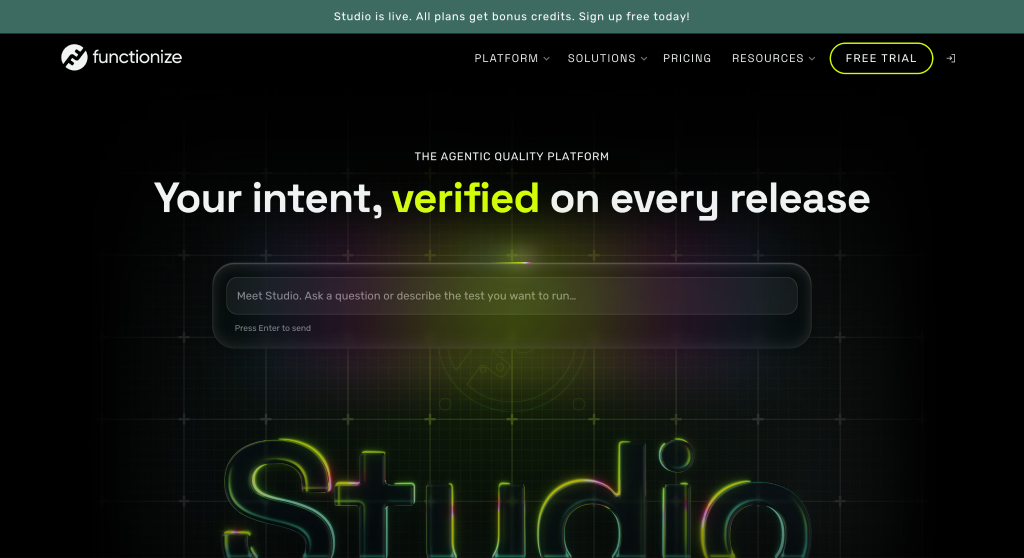
Functionize is an AI-native testing platform built around specialized agents that create, run, and maintain tests with no scripting skills required. Eight years of enterprise training and more than 30,000 data points per page give its AI a 99.97% element recognition rate, which translates directly to an 80% drop in flaky tests and maintenance burden. For teams worn down by tests that break every time the UI shifts, that number is hard to ignore.
The platform’s self-healing agents handle the kind of complex, multi-step user workflows that scripted frameworks consistently struggle to keep stable. For anyone getting started or building out a testing strategy, Functionize’s resource on automated regression testing explained walks through the concepts and mechanics behind this approach in practical, grounded terms. Non-technical team members can deploy tests up to 90% faster than traditional methods, a real difference when QA can’t afford to wait on engineering bandwidth.
Real-world outcomes back this up. GE Healthcare compressed 40 hours of testing down to 4, a 90% labor savings. Functionize was also named a Strong Performer in Forrester’s Q4 2025 Wave Report on Autonomous Testing Platforms.
2. TestMu AI
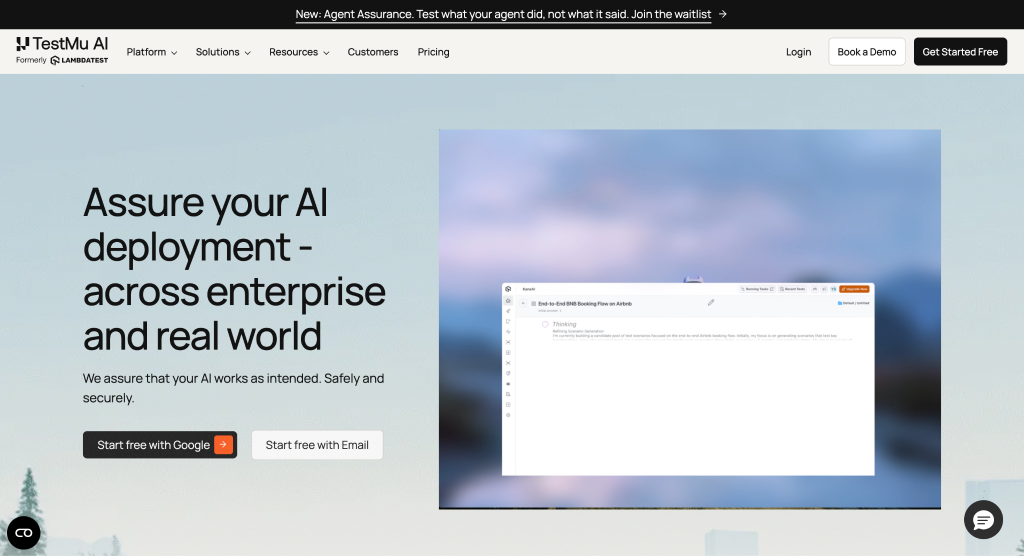
TestMu AI – rebranded from LambdaTest in 2026 – describes itself as an AI-native quality engineering platform, a shift from its original identity as a testing infrastructure provider. The rebrand reflects a genuine product evolution: its Kane AI agent now handles autonomous test generation, while HyperExecute, its orchestration engine, runs tests closer to browser infrastructure than a traditional Selenium Grid does, cutting execution time meaningfully at scale.
The infrastructure numbers are genuinely impressive. TestMu AI’s real device cloud spans more than 10,000 physical devices and 3,000-plus browser combinations, making cross-platform coverage its most obvious strength. Founded in 2017 by Asad Khan and Jay Singh and headquartered in San Francisco, the company employs around 546 people; its client base includes more than 18,000 enterprises and 3 million individual users, with Microsoft among the named accounts.
For teams that need broad device coverage alongside autonomous test generation, TestMu AI is a strong contender. The sheer scale of its device cloud is hard to match, though teams that prioritize a deeply integrated AI testing workflow may find the platform’s breadth outpaces its depth in any single area.
3. mabl
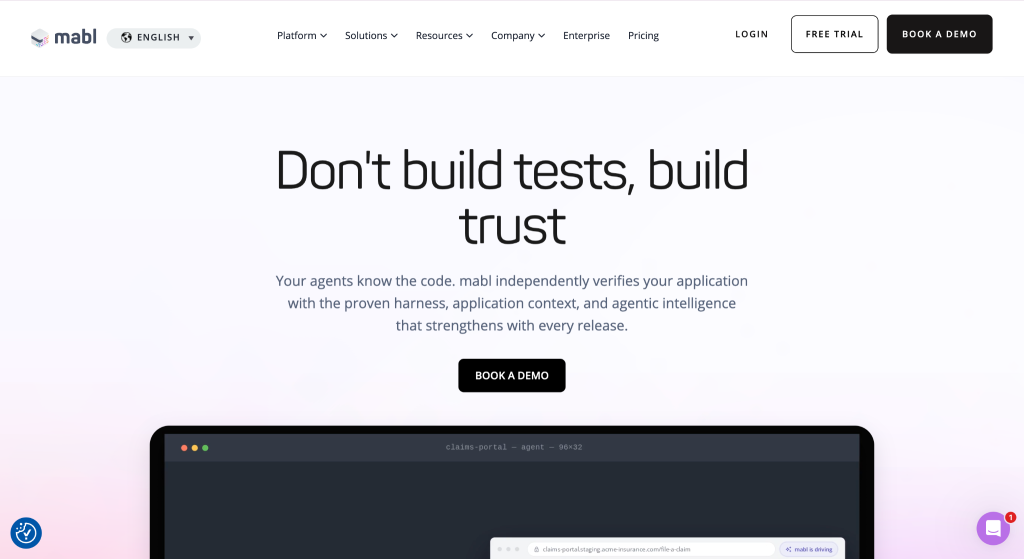
mabl is a low-code test automation platform that plants itself squarely inside the CI/CD workflow. Founded in 2016 and headquartered in Boston, it works with Azure DevOps, Jenkins, and GitHub Actions out of the box, setup is relatively quick for teams already running DevOps pipelines. Its auto-healing feature adjusts tests on its own when the application changes, cutting the manual intervention that quietly kills team velocity.
The platform covers web, mobile, and API testing in one place, with unlimited parallelization and reusable test steps. Named clients include Microsoft, Charles Schwab, JetBlue, and Chewy. At 112 employees, mabl runs as a focused, product-led company rather than a sprawling infrastructure provider.
The catch for some teams: mabl is built primarily for web and API testing, so teams with heavy native mobile testing needs may find the coverage thinner than on dedicated mobile platforms. Still, for full-stack web testing with strong DevOps setup, it’s a well-regarded option.
4. Playwright
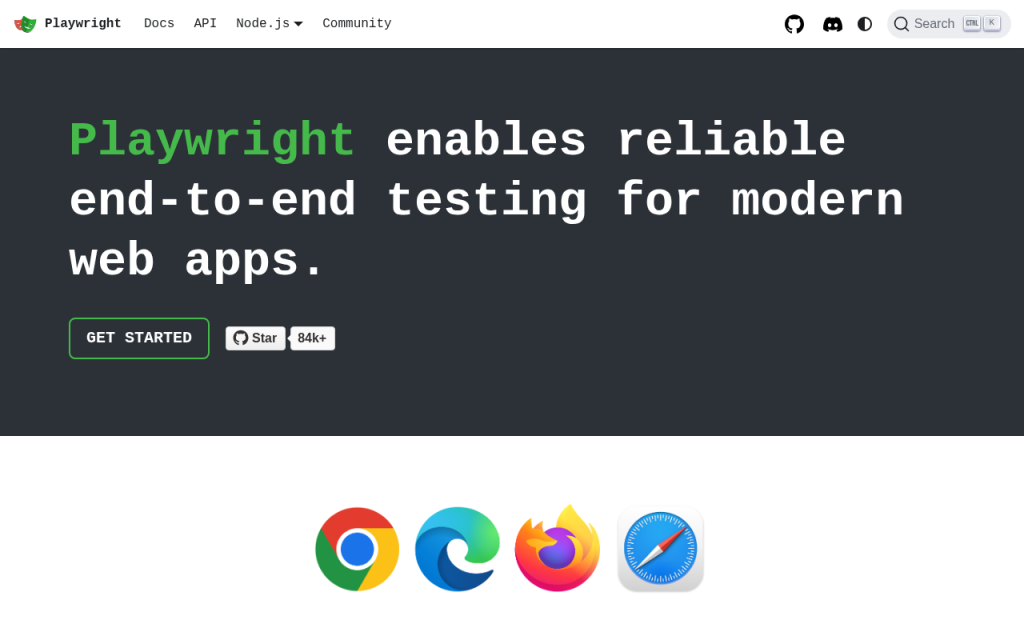
Playwright is an open-source browser automation library developed by Microsoft and launched in January 2020. It supports TypeScript, JavaScript, Python, .NET, and Java, a breadth that makes it accessible to engineering teams across very different tech stacks. The @playwright/test runner ships with Jest-like assertions and is built for end-to-end testing, so teams don’t need to bolt on a separate assertion library.
Beyond testing, Playwright has expanded to include a CLI tool for coding agents and an MCP server for AI agent connection, signals that Microsoft is positioning it as infrastructure for AI-driven workflows, not just regression coverage. Because it’s open source, there are no licensing costs, which makes it attractive for teams with the engineering capacity to build and maintain their own framework.
The tradeoff is maintenance. Playwright is a framework, not a managed platform. Teams take on the work of infrastructure, CI setup, and test stability. It’s a strong choice for experienced engineering teams; it’s a harder sell for QA teams without deep scripting skills.
5. Cypress
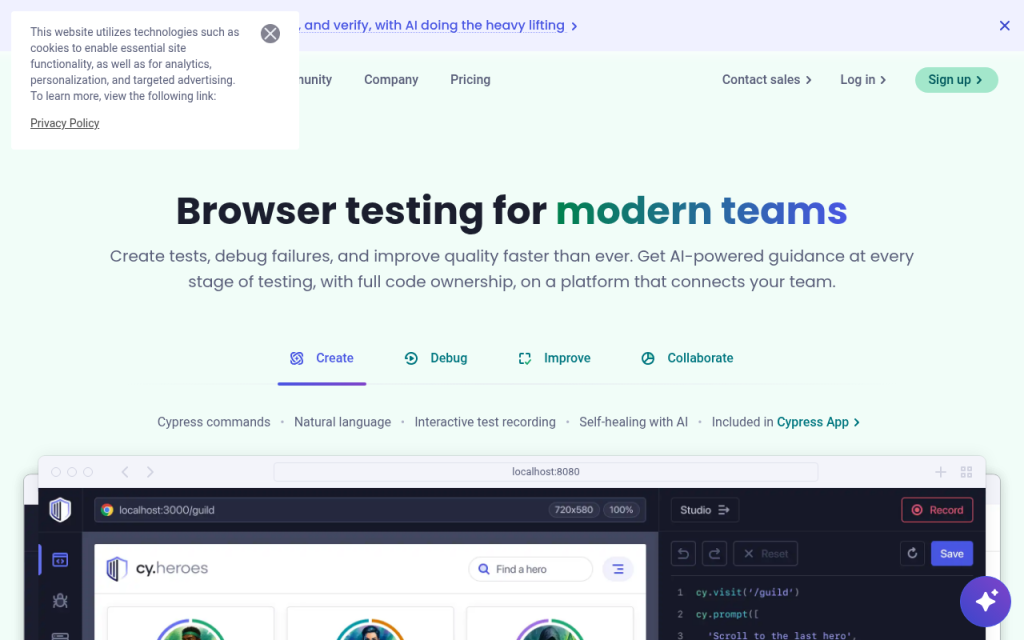
Cypress was founded in 2015 and is headquartered in Atlanta, Georgia. Its open-source app lets developers write, run, and debug tests directly inside the browser, a developer-experience-first design that sets it apart from heavier infrastructure tools. More than 3,700 customers across 78 countries and 65 industries have collectively run over 5 billion tests on the platform, with Adobe, DHL, and Kabbage among the named clients.
The platform has two tiers: the open-source Cypress App for authoring and debugging, and Cypress Cloud for managing and optimizing tests at scale with analytics, smart orchestration, and visual reviews. Recent additions include natural language test generation and AI self-healing, which bring it closer to managed platforms in reducing maintenance work.
Cypress is strongest for front-end and component testing. Teams doing heavy API or mobile-native testing will find it less suited to those use cases, but for JavaScript-heavy web apps it remains one of the most widely adopted frameworks in the ecosystem.
Bottom Line
The best automated regression testing tools split most clearly along two lines: how much automation they deliver out of the box, and how much engineering effort they demand to maintain. Fully managed AI platforms suit teams that want speed without scripting overhead. Open-source frameworks give experienced engineers flexibility and zero licensing cost, but ongoing upkeep is real. And platforms with massive device clouds solve cross-platform coverage problems that smaller tools can’t touch at scale. The right pick comes down to team size, technical depth, and where in the stack most of the regression risk actually lives.