
5 Best AI Tools That Generate Shopify Product Pages From a Product URL in 2026
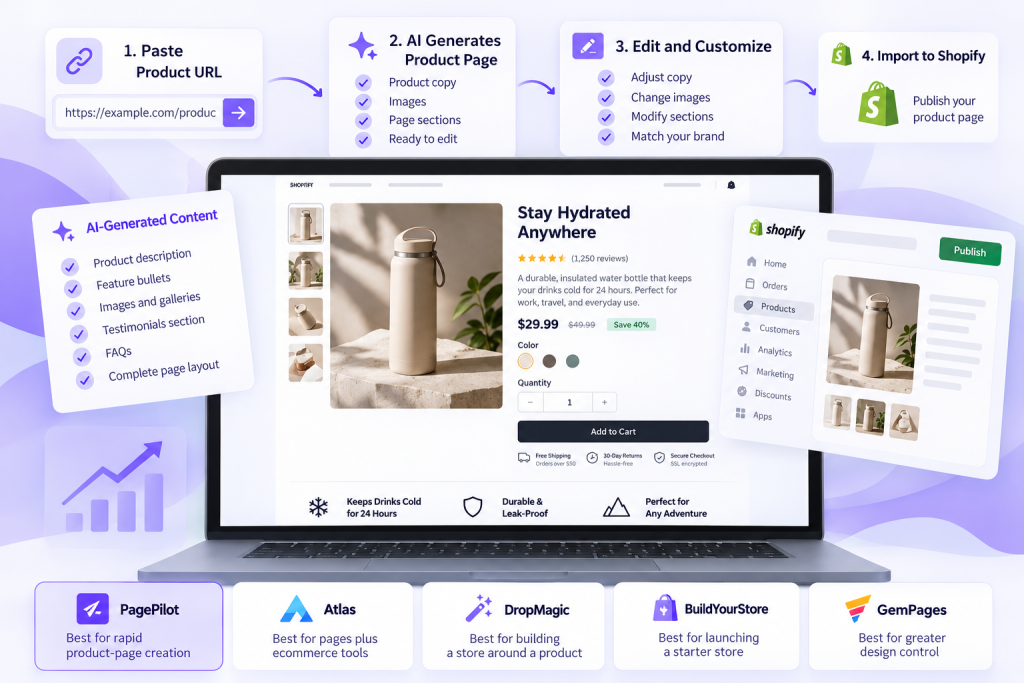
Creating a Shopify product page involves collecting product information, choosing images, writing copy, and structuring the page. For stores testing products regularly, repeating that process can slow down launches.
AI product page generators can shorten the workflow by using an existing product URL as the starting point. Some focus on URL-to-product-page generation, while others support broader store-building or visual design workflows.
Quick Comparison
Tool | Best for | Starting point | Workflow |
PagePilot | Rapid Shopify product-page creation | Product URL | AI product-page generator |
Atlas | Pages plus ecommerce tools | Product URL | AI ecommerce builder |
DropMagic | Building a store around a product | Product URL | AI store builder |
BuildYourStore | Launching a starter store | Niche/store setup | AI store builder |
GemPages | Greater design control | Product/page content | AI-assisted visual builder |
How These Tools Were Compared
The tools were compared by required input, level of automation, editing flexibility, and whether they focus on individual product pages or broader store creation. PagePilot is our product, so it is described in more detail than the others. Descriptions of the other tools are based on their published information.
1. PagePilot — Best for Turning a Product URL Into a Shopify Page
PagePilot is designed for merchants who want to generate individual Shopify product pages from existing products.
The workflow starts with a product URL. PagePilot uses the source product information to create an initial page with product copy, images, and a structured layout. Merchants can review and edit the content before importing the page into Shopify.
This makes it particularly relevant for dropshippers and ecommerce teams testing products frequently. Instead of beginning with a blank canvas, they can move from an existing product to an editable page draft. PagePilot also supports related creative workflows, including ad creation, which helps when the product page is only one stage of a larger product test.
Best for: Merchants moving from product discovery to Shopify product-page testing.
Main advantage: A direct product URL → generated page → edit → Shopify workflow.
2. Atlas — Best for Product Pages With Additional Ecommerce Tools
Atlas can create ecommerce pages from existing product links while combining page creation with additional functionality such as product imagery and upsells.
Its broader toolkit can suit merchants who want several launch-related capabilities within one platform. Sellers who only need a streamlined URL-to-page workflow may not use the full feature set.
Best for: Sellers who want AI page creation alongside additional ecommerce functionality.
3. DropMagic — Best for Building a Store Around a Product
DropMagic uses a product URL as the starting point for broader store creation.
Rather than focusing only on individual product pages, its workflow can create a multi-page store around a selected product and target audience. An existing Shopify merchant testing one more product may find a dedicated page generator more direct.
Best for: Sellers who need a broader AI-assisted store build.
4. BuildYourStore — Best for Starting a Shopify Store
BuildYourStore focuses on generating a starter Shopify store rather than repeatedly creating individual product pages.
It can set up a store with products and initial content, making it more relevant to new sellers starting from zero. Established stores adding single products may not need that broader setup.
Best for: New sellers who need a starter store rather than a standalone page generator.
5. GemPages — Best for Greater Design Control
GemPages approaches the task from the visual-builder side. It combines AI-assisted functionality with a Shopify page editor, giving merchants more control over page structure and design.
The trade-off is more hands-on work than a dedicated URL-to-page generator, which can be worthwhile for brands with specific visual requirements.
Best for: Shopify brands that want AI assistance alongside detailed visual editing.
Which Type Should You Choose?
For repeated product testing, a dedicated product-page generator provides the most direct workflow. For launching a store, an AI store builder is a better match. For custom layouts, an AI-assisted visual builder provides design control.
When importing from third-party URLs, check that you have rights before republishing descriptions, photographs, reviews, or content.
Frequently Asked Questions
Can AI generate a Shopify product page from a URL?
Yes. Some AI ecommerce tools can use a product URL and generate a product-page draft with copy, images, and page sections.
What is the difference between an AI product page generator and an AI store builder?
A product page generator creates individual product pages. An AI store builder creates a broader storefront that can include multiple pages and store elements.
Do AI-generated Shopify pages need editing?
Yes. Merchants should verify product specifications, claims, pricing, images, and shipping information before publishing.
Can I copy content from another product page?
Do not assume third-party product descriptions or images are free to reuse. Check that you have permission or rights before republishing them.