
The Manual Friction Audit: Is Your Back Office Quietly Cannibalizing Your Growth?
In the early days of a manufacturing business, “manual” is a badge of honor. It means you are hands-on, you know every dealer by name, and you personally oversee every order that crosses your desk.
But as you scale, those manual touches—once a sign of quality—quickly transform into a Success Trap. When you reach a certain volume, the very processes that helped you grow begin to act as an anchor, dragging down your efficiency, inflating your overhead, and, most dangerously, frustrating your most profitable dealers.
If your team is still relying on a “Phone, PDF, and Prayer” workflow, you aren’t just working hard; you are paying a Hidden Tax on every single unit you ship.
The “Why”: Why Manual Processes are Killing Your Margin
Why does “manual” become a problem in 2026? It comes down to Digital Maturity. In a world where your dealers can order a fleet of trucks or a household of appliances with a single click, they have lost patience for manufacturers who require a four-hour wait for a quote or a phone call for a status update.
When you operate manually, you suffer from:
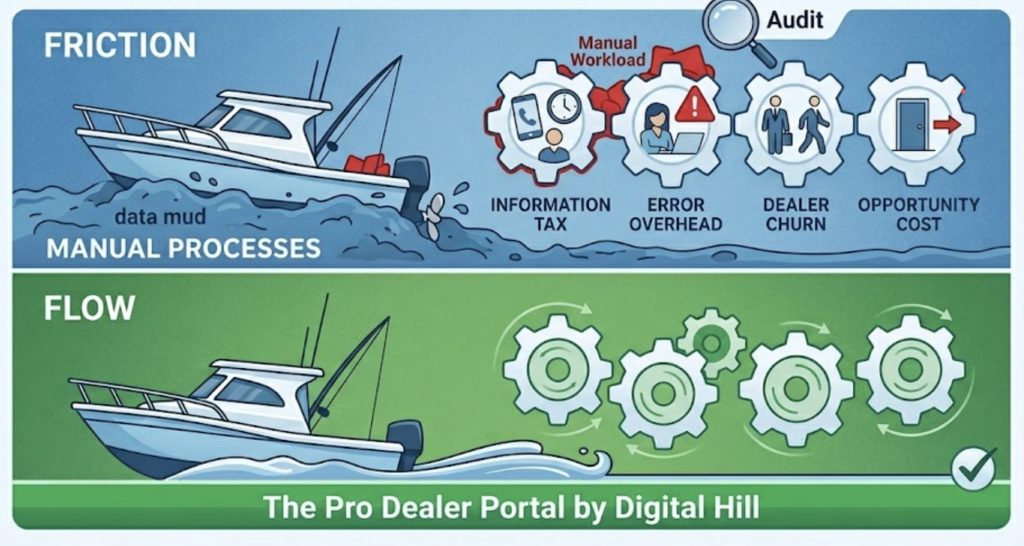
- The Information Tax: Your most talented staff members are transformed into “Information Clerks,” spending their day relaying data that should be self-service.
- The Error Overhead: Every time data is re-typed from an email into an ERP, you invite a “fat-finger” error that costs thousands in return shipping and rework.
- The Opportunity Cost: While your team is busy playing “telephone” with dealers, they aren’t identifying market trends or vetting new high-quality partners.
The 5-Point Manual Friction Audit
Take a moment to evaluate your current sales and ordering operations. If you answer “Yes” to more than two of these questions, your manual processes are likely the biggest bottleneck to your next stage of growth.
1. The Repetition Test (Information Tax)
- The Question: Does your office staff spend more than 30 minutes a day answering “Where is my order?” or “Do you have this part in stock?” calls?
- The Cost: Multiplied over a year, you are paying for a full-time salary just to repeat information that already exists in your system.
2. The “Fat-Finger” Reality Check (Error Overhead)
- The Question: Have you had to eat the cost of a shipping error or a misconfigured build in the last 90 days due to a data-entry mistake?
- The Cost: The cost of one error isn’t just the part; it’s the “rush” shipping, the wasted labor, and the intangible loss of dealer trust.
3. The Dealer Silence (Dealer Churn)
- The Question: Have your high-volume dealers become less active, or have you noticed them moving toward competitors who offer more digital self-service tools?
- The Cost: Dealers prioritize the “path of least resistance.” If your brand is high-maintenance to order, you are losing “shelf space” in their minds.
4. The PDF Graveyard
- The Question: Are you currently relying on emailed PDFs or printed price sheets that are difficult to update across your entire network simultaneously?
- The Cost: Outdated pricing leads to “price protection” claims and lost margins. If your data isn’t live, it’s already wrong.
5. The Quoting Bottleneck
- The Question: Does it take your team longer than 10 minutes to generate and return a custom quote to a dealer or prospect?
- The Cost: In the 2026 market, speed is a competitive advantage. A dealer who can’t get an instant quote for a customer on the showroom floor is a dealer who loses the sale.
What to Do After Reviewing Your Audit
If this audit revealed more friction than you expected, don’t panic. It is a sign that your brand has outgrown its current infrastructure—a high-class problem to have.
Step 1: Identify the “Loudest” Friction Point
Don’t try to boil the ocean. Identify which of the five points above is costing you the most time or money. Usually, it is either Error Overhead or the Information Tax.
Step 2: Move the “Scrubbing” to the Source
The key to moving from Friction to Flow is ensuring data is accurate at the point of origin. By implementing a Pro Dealer Portal, you empower the dealer to do the data entry once. Our Smart-Logic ensures that their order is 100% buildable before they can even hit “Submit.”
Step 3: Schedule a “Friction to Flow” Strategy Session
You don’t need a “web developer”; you need a partner who understands the unique logic of marine manufacturing. At Digital Hill, we’ve helped industry leaders like Barletta Boats and Godfrey Pontoons eliminate these hidden costs and reclaim their staff’s time.
Ready to move from Friction to Flow. Let’s talk!