
The New Google Search Playbook: Why Your Content Strategy Has A Hole (And How to Fix It)

The Google we used to know is officially a thing of the past. If your current content strategy feels like it’s stalling, there is a distinct structural reason for it: the traditional search engine layout has completely changed.
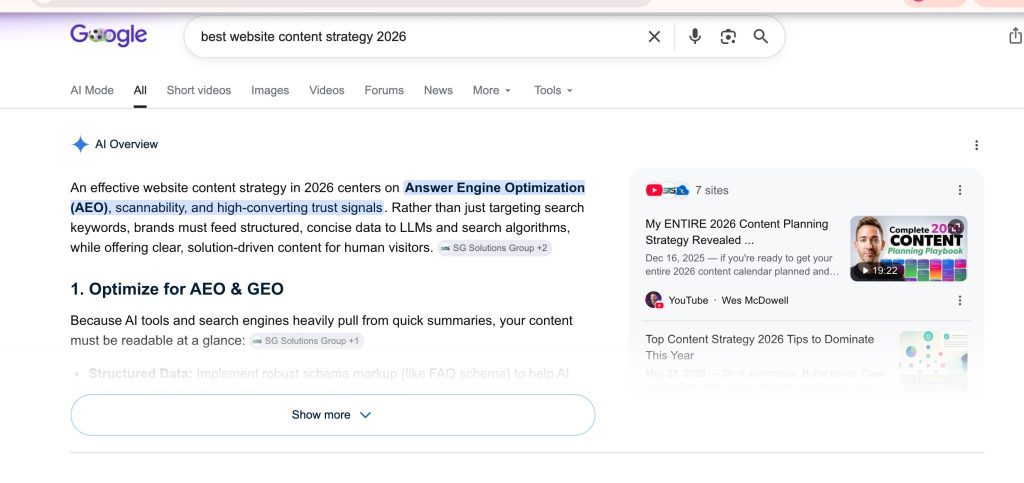
When you type a query into Google today, you no longer just see the classic “ten blue links” of the top search results.
Instead, Google utilizes its advanced generative models to display AI Overviews and conversational AI Mode blocks right at the very top of the page way before you see any search results.
These massive AI-generated text boxes synthesize information from across the web, answering the user’s question completely without forcing them to click through to an external website. It pushes standard organic search results entirely below the fold, resulting in a staggering rise in “zero-click searches.”
The hard reality for businesses? Google’s new AI search results do not need to cite you for information they can pull from generic sources.
To win on Google today, you have to create content that search engines must cite, rather than content where citation is optional. Based on recent data evaluating what AI-driven Google search results actually reference, a clear hierarchy has emerged. If your content production is weighted toward formats automated tools can easily replicate, your traffic and visibility will plummet.
Here is how you need to reallocate your content focus today to stay relevant on Google Search.
1. The Undisputed King: Original Research (82% Performance Rate)
Original research sits at the very top of Google performance metrics at 82%. Why? Because proprietary survey data, original analysis, and unique datasets are fundamentally irreplaceable.
When Google’s AI synthesizes an answer for a user, it can pull generic facts from its existing index. But it cannot invent a specific, proprietary statistic. If your business publishes a unique industry dataset, Google has to cite your website because that information simply does not exist anywhere else. You convert a citation from a choice into an absolute requirement.
How to execute it:
- Don’t just publish text: Include a clear methodology section outlining your sample size and collection methods to build machine and user trust.
- Lead with a hook: Use a headline statistic that is specific, surprising, and clearly attributable.
- Optimize for extraction: Use structured data markup to help search crawlers easily parse the context, and publish a dedicated data page presenting key findings in a clean format alongside your full analysis.
2. The High-Value Runner-Up: Deep Comparison Content (76% Performance Rate)
Comparison content ranks second at 76%, sharing a critical trait with original research: it requires judgments, conclusions, and data points specific to your unique perspective and methodology.
For example, a comparison of five major software platforms based on your company’s proprietary testing criteria is something Google’s AI cannot replicate without referencing you. However, a lazy comparison page that just reiterates basic feature lists available on the competitors’ own websites will plummet, performing closer to a generic blog post at a lowly 25%.
How to execute it:
- Build a comparison content library for your top five product or service categories.
- Ensure every comparison is built on your own benchmarks, unique evaluation criteria, or hands-on testing.
3. The Mid-Tier: Rankings, Best Lists, and FAQs (57% – 41% Performance Rate)
As we drop from comparison content to rankings (57%) and FAQs (41%), we see a slide in content specificity and citation necessity.
Rankings are highly replicable by automated tools. FAQs contain question-and-answer formats that search engines can construct independently. However, FAQs punch above their weight class on Google because their quick, conversational structure perfectly mirrors how natural language algorithms formulate answers.
How to execute it:
- Add an FAQ section to every major page on your site.
- Write them in natural, conversational language that mirrors how users phrase questions in Google Search.
- Make each entry self-contained—meaning a user can completely understand the answer without needing context from the rest of the page.
The Content Investment Directive: Audit Your Budget
Look closely at the data:
Content Type | Performance / Google Citation Reliability |
Original Research | 82% (Highest reliability; irreplaceable data) |
Comparison Content | 76% (Requires proprietary testing/methodology) |
Rankings & Best Lists | 57% (Automated tools can easily replicate) |
FAQs | 41% (Matches search query response structures) |
Generic Blog Posts | 25% (Low value; easily replicated by competitors/AI) |
- Source: NP Digital, May 2026. Sample size: 500 marketers and business owners.
This ranking is a direct content investment directive. If you are still spending 100% of your budget on generic, top-of-funnel articles, you are burning cash.
To survive the evolution of Google Search, you must audit your current content production budget and shift at least 30% of your generic blog budget toward original research and proprietary comparison content formats.
Let’s Modernize Your Digital Strategy
Navigating the massive shifts in Google Search visibility isn’t something you have to figure out alone. At Digital Hill, we specialize in building the high-performing web infrastructure, custom software tools, and data-driven marketing strategies that keep businesses ahead of the curve.
Ready to stop wasting budget on content that gets ignored?
Contact Digital Hill today to schedule a strategy consultation.
Let’s audit your current approach and build a web presence designed to win in the modern search landscape.